
How to Thread a Ratchet Strap (Step-by-Step)
Learn how to thread a ratchet strap step by step: open the handle, feed the webbing without twists, tension it safely and release it correctly for every load.
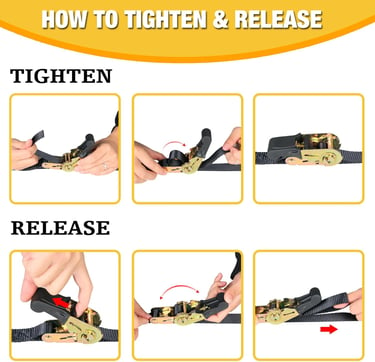
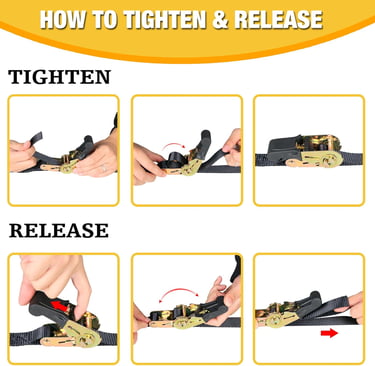
Threading a ratchet strap the wrong way is the number one reason straps spin freely without ever getting tight. Done correctly, threading takes fifteen seconds and gives you a strap that tensions evenly, locks flat and holds for the whole trip. This guide covers the threading steps, how to press the release lever to open the spool, tensioning, and the working load limits you need to respect.
Why Proper Ratchet Strap Threading Matters
Ratchet straps secure cargo in trucks, trailers, moving vans and on construction sites. Incorrect threading leads to strap slippage, cargo damage and failed roadside inspections. Under FMCSA 49 CFR §393.106, the combined working load limit of your tie-downs must be at least half the cargo weight — and that rating only counts when the webbing is threaded and seated properly.
Maximize load security: a correctly threaded spool grips the webbing so it cannot feed backwards.
Extend strap lifespan: twists and mis-feeds fray the fibers and cut working strength.
Comply with safety standards: OSHA and DOT inspectors check tie-down condition and WLL compliance.
Before You Thread: Inspect the Strap
Check for frayed webbing, cracked ratchet teeth, bent hooks and broken stitching. A strap with cuts deeper than a quarter inch must be retired — webbing cannot be repaired, only replaced. Full inspection details are in our ratchet strap inspection guide.
Step by Step: How to Thread a Ratchet Strap
Open the ratchet. Press the release tab and flip the handle all the way open so the spool spins free. If the handle feels stuck, pull the loose webbing toward the buckle first to relieve pressure — never force it.
Feed the webbing through the center slot. Push the free end of the strap through the slot in the spool axle, from the side without the buckle's fixed strap.
Pull the tail through. Draw 8–12 inches (20–30 cm) of webbing through so it cannot slip back out of the slot.
Remove every twist, then confirm that threading the strap has not reversed the weave — pulling the strap straight through the spool keeps it centred, and a ratcheting handle that turns freely tells you the feed is correct. Walk the strap's full length and confirm it lies flat. Twisted webbing cuts working strength and wears the fibers against the spool.
Hook both ends. Attach the hooks to solid anchor points straight over the load — not around sharp edges — and pull the slack out by hand until the strap sits snug.
Tension and Lock the Strap
Pump the handle up and down three to six times; each stroke reels in two to three inches of webbing. Stop when the strap is tight and the cargo cannot be shifted by hand, then push the handle down flat until it clicks into the locked position. A handle left half-open works loose on the road. Hold the tail strap while tensioning to keep the webbing flat against the axle.
How to Release and Unthread Safely
To release, press and hold the release lever while lifting the handle back to the open position — tension drops instantly. Pull the free end of the webbing out of the center slot and unwrap the spool. If the handle will not lift, the spool is still under load: relieve tension from the tail side first. Never hammer or pry the handle; a bent release mechanism is the most common cause of permanently jammed buckles.
Working Load Limits and Safety Notes
Every strap carries a tag listing its working load limit (WLL) and break strength. WLL is roughly one third of break strength, and it is the number all cargo rules are written against: a 1-inch strap typically holds about 833 lbs WLL, a 2-inch strap 1,667–3,333 lbs, and a 4-inch strap up to 5,400 lbs. Never exceed the tag value, and add a strap whenever the load can tip or slide independently.
Common Threading Mistakes to Avoid
Threading backwards: the webbing must wrap the axle once; threaded the wrong way, the strap spins without tightening.
Over-tightening: crush damage on boxes, boats and motorcycle handlebars — use soft loops or edge protection instead of raw tension.
Twisted webbing: always align the strap parallel to the axle before tensioning.
Half-seated hooks: a hook that is not fully seated jumps off under road shock.
Maintain Your Ratchet Straps
Clean webbing with mild soap and water, store straps in a dry area out of direct sunlight, and inspect monthly for wear, rust or deformation. Straps used in wet conditions should be dried before storage to protect the hardware from corrosion.
FAQ: Threading Ratchet Straps
Can I thread ratchet straps in wet conditions?
Yes — polyester webbing works wet or dry. Dry the strap thoroughly afterward and check the hardware for corrosion before the next use.
How many times can I reuse a ratchet strap?
Industrial-grade straps handle hundreds of tension cycles with proper care. The limiting factor is webbing condition, not cycle count — retire the strap at the first sign of cuts or broken stitching.
What is the difference between threading and setting up a strap?
Threading is just feeding the webbing through the spool. Setting up covers the whole job: load assessment, anchor points, threading, tensioning and final checks — see our guide on how to set up a tie down strap for the complete routine.
Where can I learn the full tie-down process?
Our complete guide to using ratchet straps covers hook selection, truck bed tie-downs, release technique and FMCSA compliance in detail.
Need straps for a fleet or retail program? Truckbrotools manufactures ratchet tie down straps in a GS and TÜV certified factory, with OEM/ODM branding and wholesale MOQ from 100–500 pcs. Contact us for a factory-direct quote.More Ways to Ask: Ratchet Strap Threading FAQ
How do I thread a ratchet strap? Open the ratchet handle flat, feed the webbing up through the mandrel slot from below, pull the slack through, then crank the handle to tension.
How do you thread a ratchet strap, or how to thread a ratchet tie down strap? The same procedure applies to every standard ratchet tie down: keep the webbing flat and untwisted before tightening.
Ratchet tie down how to thread, how to string ratchet straps, or thread ratchet strap? All of these describe the threading method shown in the steps above.
How to thread a ratcheting strap or how to thread ratchet tie down straps? Ratcheting straps use the same spindle. For strap ratings and working load limits, see heavy duty ratchet straps.
Related guides: how to use a ratchet strap with hooks, motorcycle tie down straps, and wholesale bungee cords.

Subscribe to our newsletter
sales@truckbrotools.com


CORE VALUES
Quality Craftsmanship
Safety First
Versatile Applications
Constant Innovation
Customer Commitment